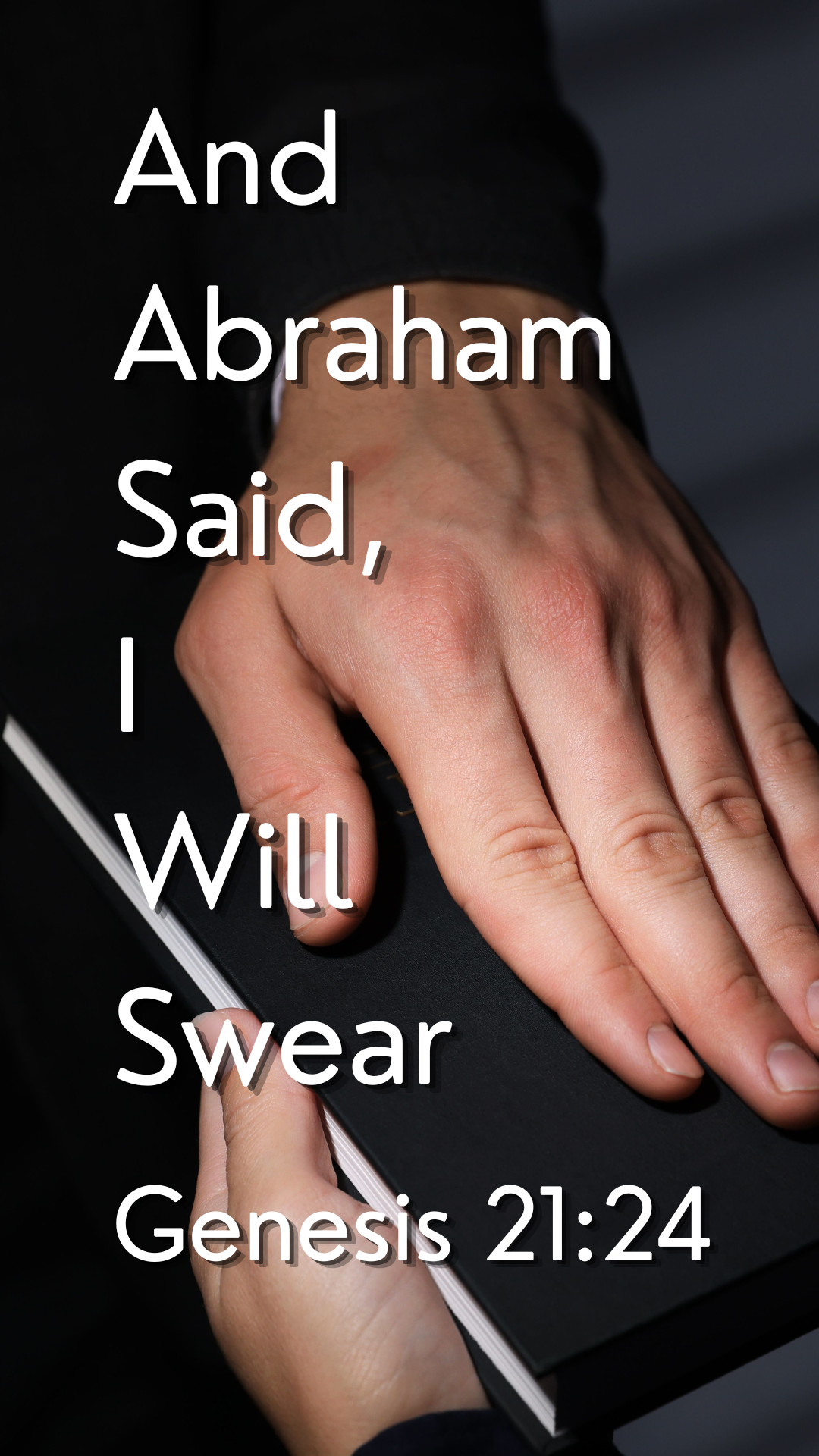
There’s a moment in Genesis that’s easy to skim right past. Abimelech comes to Abraham and asks him to swear an oath of loyalty, and Abraham’s answer is just three words: “I will swear” (Genesis 21:24). No hesitation. No conditions. No asking for time to think it over.
"And Abraham said, I will swear." — Genesis 21:24 (KJV)
It’s a small verse, but it holds a big principle: when we give our word, God expects us to keep it, whether that word is given to Him or to another person.
The Weight Behind “I Will”
Abraham’s oath in Genesis 21 wasn’t costly. It was a simple agreement of goodwill between two men. But Scripture shows us that the same law of “your word is your bond” applies even when keeping a vow becomes far more difficult.
Judges 11 records the vow of Jephthah, who promised the LORD that if he was given victory over the Ammonites, he would offer up as a burnt offering whatever came out of the doors of his house to meet him when he returned. It was his own daughter who came out first.
"And Jephthah vowed a vow unto the LORD, and said, If thou shalt without fail deliver the children of Ammon into mine hands, Then it shall be, that whatsoever cometh forth of the doors of my house to meet me, when I return in peace from the children of Ammon, shall surely be the LORD's, and I will offer it up for a burnt offering." — Judges 11:30–31 (KJV)
This story gets misunderstood often. Many assume Jephthah killed his daughter. But a closer reading tells a different story. When his daughter learns of the vow, she asks for two months to go and “bewail her virginity” (Judges 11:37), not her death. And Judges 11:39 tells us that after the vow was fulfilled, “she knew no man.”
"And it came to pass at the end of two months, that she returned unto her father, who did with her according to his vow which he had vowed: and she knew no man." — Judges 11:39 (KJV)
Jephthah didn’t sacrifice his daughter’s life. He dedicated her, permanently, to the service of the LORD, a life set apart, with no marriage and no children.
That was still an enormous cost. It meant giving up grandchildren, giving up the future he likely imagined for her. And yet Jephthah didn’t go back on what he had promised. Once the vow was spoken to God, it was binding, no matter what it ended up costing him.
Paul’s Word, and God’s
The New Testament gives us another angle on this same principle, this time about keeping our word to other people, not just to God.
In 2 Corinthians 1, Paul is defending himself. He had told the church at Corinth he would visit them, then changed his plans, and some were accusing him of being unreliable, of saying yes and meaning maybe. Paul asks them directly: “did I use lightness?” (2 Corinthians 1:17).
His answer is important, and so is his explanation. In verses 23 and 24, Paul explains that he stayed away not because his word meant nothing, but “to spare” the Corinthians, so that he wouldn’t have to come to them in a way that caused unnecessary pain. He wasn’t trying to control their faith. He says he was working for their joy.
"Moreover I call God for a record upon my soul, that to spare you I came not as yet unto Corinth. Not for that we have dominion over your faith, but are helpers of your joy: for by faith ye stand." — 2 Corinthians 1:23–24 (KJV)
Then Paul makes the larger point in verses 18 and 19:
"But as God is true, our word toward you was not yea and nay. For the Son of God, Jesus Christ, who was preached among you by us, even by me and Silvanus and Timotheus, was not yea and nay, but in him was yea." — 2 Corinthians 1:18–19 (KJV)
Paul ties his own reliability directly to the character of God. Because Christ’s promises never waver, Paul’s word shouldn’t waver either.
The Same Principle, Old Testament and New
Put Genesis 21:24 and 2 Corinthians 1 side by side and you see the same truth stretching across the whole of Scripture. Abraham’s simple, immediate “I will swear” and Paul’s careful defense of his own integrity are both rooted in the same idea: our word, whether to God or to the people around us, should be dependable.
That doesn’t mean plans never change or delays never happen. Paul’s own situation shows that a genuine, thoughtful reason for a delay isn’t the same thing as breaking your word. What it does mean is that we shouldn’t be people who:
- Say Yes CarelesslyTossing out a quick “yeah, I’ll be there” without ever meaning to follow through.
- Promise Without Counting the CostMaking commitments we haven’t thought through, then being surprised when they cost us something.
- Treat Commitments as NegotiableDropping our word the moment it becomes inconvenient.
Ecclesiastes 5:5 puts it plainly:
"Better is it that thou shouldest not vow, than that thou shouldest vow and not pay." — Ecclesiastes 5:5 (KJV)
The lesson isn’t to avoid ever making commitments. It’s to weigh our words carefully before we speak them, and once we’ve said “I will,” to be the kind of people who mean it.
Weigh your words before you speak them —
and once you’ve said “I will,” mean it.