Short Verses. BIg Impact.

Throwing Out the Calendar: How my Single Mom Found Freedom and Led Me to the Truth
This blog post shares a family’s journey of trading the heavy financial and emotional burdens of cultural holiday traditions for the "light yoke" of scriptural simplicity, honesty, and peace.
EASY YOKE
4/5/20264 min read

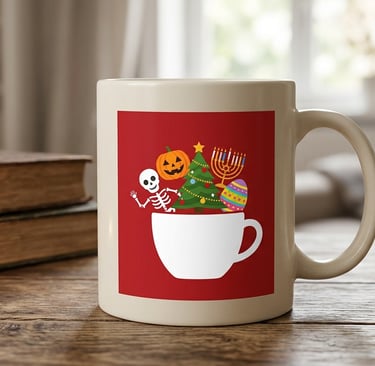
Throwing Out the Calendar: How my Single Mom Found Freedom and Led Us to the Truth
It started, like many great movements of faith, in the dark. 2:00 AM, to be exact.
I remember my mom, exhausted. She wasn’t just "tired." She was a walking ghost. A single mom working a brutal shift, starting at 2:00 AM and running full tilt until 9:00 AM. She’d crawl back home, not to sleep, but to begin her "second shift": homeschooling us. It was a chaotic, beautiful mess, but it was fueled by coffee and desperation.
We didn’t know it then, but that desperation was about to set us free.
You see, the exhaustion wasn’t just physical. It was spiritual. It was the crushing weight of expectation. It was the feeling that she had to perform, to curate, to manufacture a perfect "Christian life." And the holidays—man, the holidays were the absolute heaviest part of that burden.
The world (and honestly, the Church) told her these days were joyful. They were vital. For her, they were a marathon of financial strain, consumerism, and forced nostalgia that she just didn’t have the energy or the money for. The pressure to make Christmas "magical" or Easter "perfect" was a yoke she couldn't carry.
Looking for an Exit
That 2:00 AM exhaustion drives you to questions. Is this it? Is this the "abundant life" Jesus promised?
She started asking tough questions about the holidays themselves. She looked at Christmas, with its tinsel and trees and commercial frenzy. She looked at Easter, with its eggs and bunnies. And as she researched, she found what so many have found: a chaotic mix of ancient pagan customs and modern marketing, all papered over with the name of Christ.
She read Colossians 2:8, which warns, "Beware lest any man spoil you through philosophy and vain deceit, after the tradition of men, after the rudiments of the world, and not after Christ."
She realized these weren’t commands; they were customs. They were, in the words of 1 Peter 1:18, "vain conversation received by tradition from your fathers."
So, she made a radical move. She tossed out every holiday.
The Problem with "Better" Traditions
But the desperation was still there. She thought she needed something. She figured, "If I’m going to have holy days, they should be the real holy days, the ones in the Bible!" She threw herself into keeping the Jewish festivals. She thought that swapping paganism for Old Testament command would bring peace.
It didn't. It was just a different kind of heavy.
Instead of a Christmas tree, there was a fancy lamb she couldn’t afford. Instead of candy canes, there were specific frying foods she didn't have time for. Eight-day festivals that demanded even more of her non-existent energy. Foreign languages she didn't understand. Special candles. Gifts. The burden had changed shape, but it was just as suffocating.
And then, she started doing that simple math again.
She read her Bible. She looked at the instructions for the Tabernacle Menorah. It had seven branches. But her Hanukkah menorah had nine. Where did that come from? She read the account of Passover. It didn't mention the complicated, structured Seder plate she was struggling to organize.
She was exhausted, and she couldn't "make it make sense." She couldn't find the traditions of these holidays in the text she loved. She saw them as human inventions, just like the others.
The final straw wasn't theological; it was relational. She found that the stress of maintaining these "pure" traditions was actually distracting her from us. The "special days" made it harder to be present and deal with the very real, very un-special everyday problems of raising kids.
Frustration was turning to bitterness. She realized she was serving the tradition instead of the Savior.
She looked at her worn-out Bible. She looked at the cluttered calendar. And she made her final, most desperate choice. She chose the Bible.
"It was either the Bible or the tradition," she told me. "And I couldn't carry the tradition anymore."
Choosing Liberty: The Freedom in a Regular Day
That’s how she found the third truth—the one that really matters: the liberty.
She read Romans 14:5: “One man esteemeth one day above another: another esteemeth every day alike. Let every man be fully persuaded in his own mind.”
The pressure vanished. She realized she didn't have to pick a day. She didn't have to keep Hanukkah or Christmas or Easter. She had the permission—no, the mandate—to be "persuaded in her own mind."
And what was her mind persuaded of? That Jesus had set her free. She didn't need a special calendar to remember Him. She needed Him at 2:00 AM when she woke up. She needed Him at 10:00 AM when she was crying over teaching fractions. She needed Him in the ordinary, the messy, and the exhaustion.
For us, every day became the Lord's. It was a constant, non-hyped devotion, not a rollercoaster of festival highs and financial lows. This wasn't a new burden; it was a way of living that was lighter.
And we were following in good footsteps. We learned that Socrates Scholasticus, an 5th Century Historian, noted that neither the Apostles nor the Gospels imposed the "yoke of bondage" of keeping festivals like Easter, suggesting such things were kept by custom rather than divine law. We learned about groups like the Puritans, who are the most prominent group criticized by the established Church for this view. They banned Christmas and Easter in various colonies, calling them "human inventions" and "popish vanities" not found in the New Testament.
My mom’s choice wasn’t driven by legalism or a desire to be different. It was born from a place of spiritual poverty, of total exhaustion. She had nothing left to give the world’s traditions or even religious ones. She had to throw everything out so that she could focus solely on the precious blood of Christ, which had truly redeemed her.
And in that desperate freedom, she showed me the most beautiful, sustainable way to live for Jesus. It's not in the spectacular special events. It’s in the faithful, ordinary life, lived with an eye towards Him, every single day.