Ever notice how Jesus never seems shocked or confused by anything? That’s because He tells us first.
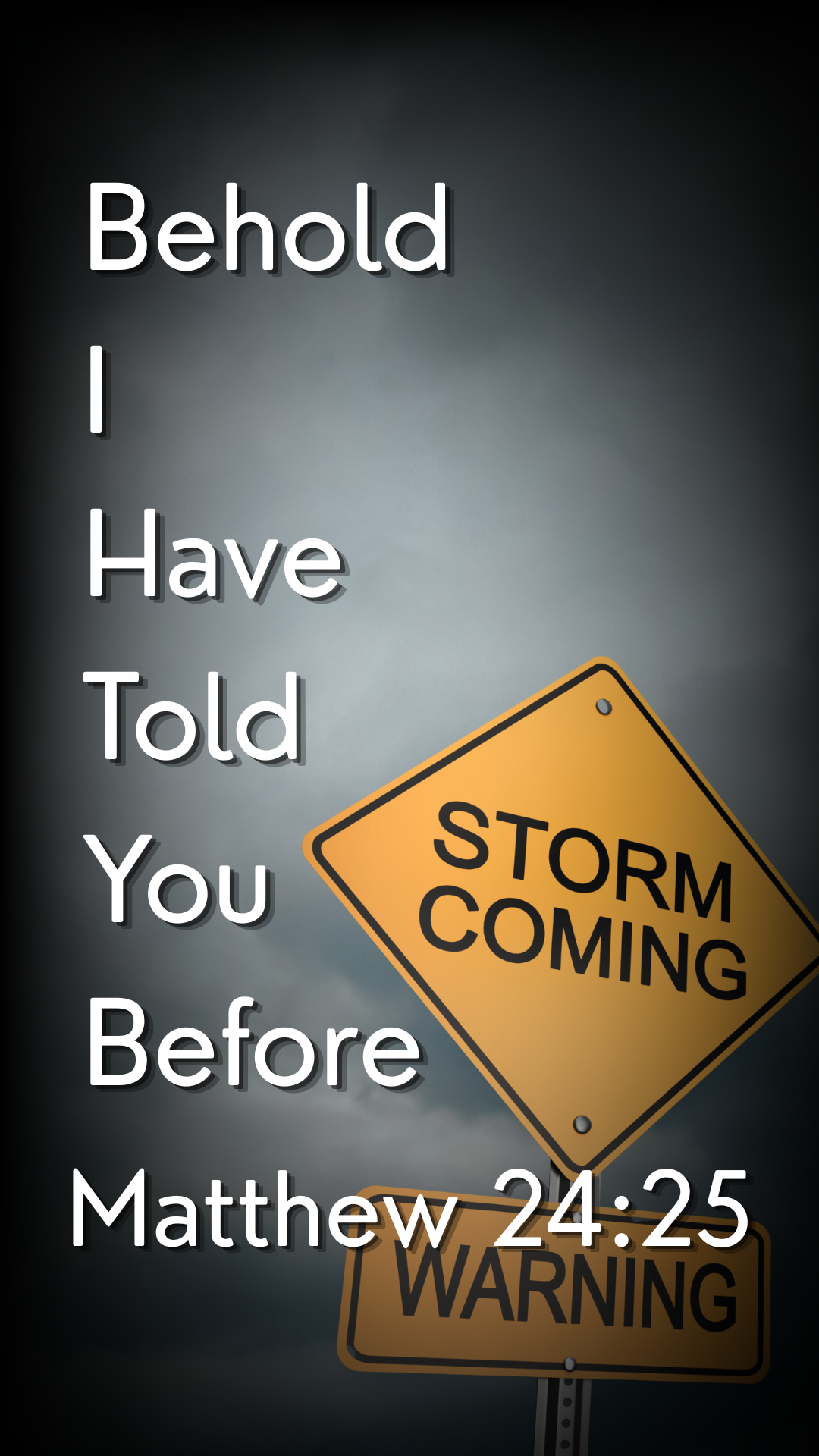
"Behold, I have told you before." — Matthew 24:25 (KJV)
What Has He Told Us?
Deception. Betrayal. Trials. He lays it out ahead of time so that when it hits, we’re not shaken. We’re standing on something.
"And now I have told you before it come to pass, that, when it is come to pass, ye might believe." — John 14:29 (KJV)
The warning isn’t meant to scare us. It’s meant to anchor our faith before the storm gets here.
Jesus Warned Us About Deception
The very first thing Jesus said when the disciples asked about the end was a warning about being deceived:
"And Jesus answered and said unto them, Take heed that no man deceive you. For many shall come in my name, saying, I am Christ; and shall deceive many." — Matthew 24:4–5 (KJV)
"And many false prophets shall rise, and shall deceive many." — Matthew 24:11 (KJV)
"For there shall arise false Christs, and false prophets, and shall shew great signs and wonders; insomuch that, if it were possible, they shall deceive the very elect." — Matthew 24:24 (KJV)
And long before the Olivet Discourse, He told us these deceivers would not look dangerous:
"Beware of false prophets, which come to you in sheep's clothing, but inwardly they are ravening wolves." — Matthew 7:15 (KJV)
Are false Christs people claiming to literally be Jesus? Sometimes. But “Christ” means Anointed One. So He’s warning about anyone claiming a special anointing, a counterfeit authority, to pull believers off course.
It isn’t always someone shouting, “I’m Jesus.” More often it’s someone claiming, “God gave me the real word, the real power, the real path.”
Jesus Warned Us About Betrayal
Deception comes from the outside. Betrayal comes from close by, and Jesus didn’t soften it.
"And then shall many be offended, and shall betray one another, and shall hate one another." — Matthew 24:10 (KJV)
"And ye shall be betrayed both by parents, and brethren, and kinsfolks, and friends; and some of you shall they cause to be put to death." — Luke 21:16 (KJV)
He even warned that some would betray believers while thinking they were serving God:
"These things have I spoken unto you, that ye should not be offended. They shall put you out of the synagogues: yea, the time cometh, that whosoever killeth you will think that he doeth God service." — John 16:1–2 (KJV)
"But these things have I told you, that when the time shall come, ye may remember that I told you of them." — John 16:4 (KJV)
He did the same thing with His own betrayal. At the last supper, He told the twelve that one of them would hand Him over, and He told them why He was telling them in advance:
"Now I tell you before it come, that, when it is come to pass, ye may believe that I am he." — John 13:19 (KJV)
"When Jesus had thus said, he was troubled in spirit, and testified, and said, Verily, verily, I say unto you, that one of you shall betray me." — John 13:21 (KJV)
Notice He was troubled in spirit. Being warned ahead of time doesn’t mean betrayal won’t hurt. It means it won’t overthrow your faith.
It Happened Just As He Said: The Book of Acts
The early church didn’t have to wait long to see these warnings come true.
The betrayer. Before Pentecost, Peter stood up and explained that Judas’s betrayal had been foretold all along:
"Men and brethren, this scripture must needs have been fulfilled, which the Holy Ghost by the mouth of David spake before concerning Judas, which was guide to them that took Jesus." — Acts 1:16 (KJV)
Men who claimed to be somebody. When the council wanted to kill the apostles, Gamaliel reminded them of two men who had drawn followings and then collapsed:
"For before these days rose up Theudas, boasting himself to be somebody; to whom a number of men, about four hundred, joined themselves: who was slain; and all, as many as obeyed him, were scattered, and brought to nought. After this man rose up Judas of Galilee in the days of the taxing, and drew away much people after him: he also perished; and all, even as many as obeyed him, were dispersed." — Acts 5:36–37 (KJV)
A man claiming special power. In Samaria, Philip met a man who had convinced a whole city that he carried God’s power:
"But there was a certain man, called Simon, which beforetime in the same city used sorcery, and bewitched the people of Samaria, giving out that himself was some great one: To whom they all gave heed, from the least to the greatest, saying, This man is the great power of God." — Acts 8:9–10 (KJV)
That is exactly the counterfeit anointing Jesus described. Simon didn’t claim to be Jesus. He claimed to be the one with the power.
A false prophet at the governor’s side. On Cyprus, Paul and Barnabas ran into “a certain sorcerer, a false prophet, a Jew, whose name was Barjesus” (Acts 13:6), who tried to turn the deputy of the island away from the faith. Paul didn’t mince words:
"O full of all subtilty and all mischief, thou child of the devil, thou enemy of all righteousness, wilt thou not cease to pervert the right ways of the Lord?" — Acts 13:10 (KJV)
Wolves from inside the flock. When Paul said goodbye to the elders of Ephesus, he warned them that the danger would not only come from outside:
"For I know this, that after my departing shall grievous wolves enter in among you, not sparing the flock. Also of your own selves shall men arise, speaking perverse things, to draw away disciples after them. Therefore watch, and remember, that by the space of three years I ceased not to warn every one night and day with tears." — Acts 20:29–31 (KJV)
Of your own selves. Some of the wolves would come from the elders’ own ranks. And Paul’s answer was the same as Christ’s: I warned you ahead of time, so remember.
Paul Kept Telling Them Before
Paul’s letters are full of the same pattern. He warned the churches in advance, and then reminded them that he had.
"Let no man deceive you by any means: for that day shall not come, except there come a falling away first, and that man of sin be revealed, the son of perdition... Remember ye not, that, when I was yet with you, I told you these things?" — 2 Thessalonians 2:3, 5 (KJV)
He warned that deceivers would look like ministers of righteousness:
"For such are false apostles, deceitful workers, transforming themselves into the apostles of Christ. And no marvel; for Satan himself is transformed into an angel of light. Therefore it is no great thing if his ministers also be transformed as the ministers of righteousness; whose end shall be according to their works." — 2 Corinthians 11:13–15 (KJV)
He warned that no messenger, however impressive, outranks the gospel:
"But though we, or an angel from heaven, preach any other gospel unto you than that which we have preached unto you, let him be accursed." — Galatians 1:8 (KJV)
He warned that smooth talk is one of the deceiver’s main tools:
"Now I beseech you, brethren, mark them which cause divisions and offences contrary to the doctrine which ye have learned; and avoid them. For they that are such serve not our Lord Jesus Christ, but their own belly; and by good words and fair speeches deceive the hearts of the simple." — Romans 16:17–18 (KJV)
He warned that shallow believers are the easiest to carry off:
"That we henceforth be no more children, tossed to and fro, and carried about with every wind of doctrine, by the sleight of men, and cunning craftiness, whereby they lie in wait to deceive." — Ephesians 4:14 (KJV)
And he warned that people would go looking for deceivers on purpose:
"Now the Spirit speaketh expressly, that in the latter times some shall depart from the faith, giving heed to seducing spirits, and doctrines of devils." — 1 Timothy 4:1 (KJV)
"For the time will come when they will not endure sound doctrine; but after their own lusts shall they heap to themselves teachers, having itching ears; And they shall turn away their ears from the truth, and shall be turned unto fables." — 2 Timothy 4:3–4 (KJV)
Paul Knew Betrayal Too
Paul didn’t only write about betrayal. He lived it.
He dealt with “false brethren unawares brought in, who came in privily to spy out our liberty which we have in Christ Jesus, that they might bring us into bondage” (Galatians 2:4).
Near the end of his life, he watched people he had worked beside walk away:
"This thou knowest, that all they which are in Asia be turned away from me; of whom are Phygellus and Hermogenes." — 2 Timothy 1:15 (KJV)
"For Demas hath forsaken me, having loved this present world, and is departed unto Thessalonica." — 2 Timothy 4:10 (KJV)
Demas wasn’t a stranger. Paul had named him among his fellowlabourers (Philemon 1:24). And then there was this:
"Alexander the coppersmith did me much evil: the Lord reward him according to his works." — 2 Timothy 4:14 (KJV)
"At my first answer no man stood with me, but all men forsook me: I pray God that it may not be laid to their charge." — 2 Timothy 4:16 (KJV)
Look at how Paul responds:
- He Names It HonestlyHe doesn’t pretend it didn’t happen.
- He Leaves the Judgment With the Lord“The Lord reward him according to his works.”
- He Prays for Those Who Abandoned Him“I pray God that it may not be laid to their charge.”
Betrayal didn’t catch him off guard, and it didn’t make him bitter. He had been told before.
Test It, Don’t Follow It
Christ told us before so we would test it, not follow it. And the church in Acts shows us what that looks like:
"These were more noble than those in Thessalonica, in that they received the word with all readiness of mind, and searched the scriptures daily, whether those things were so." — Acts 17:11 (KJV)
"Prove all things; hold fast that which is good." — 1 Thessalonians 5:21 (KJV)
Deceivers will claim a special word. Betrayers will come from close by. None of it should shock us, because none of it is news. Jesus warned us, the apostles watched it happen, and Paul kept reminding the churches that he’d said so.
"Behold, I have told you before." — Matthew 24:25 (KJV)
He isn’t just warning us.
He’s preparing us.
Follow Bible Memory Bros
Follow Bible Memory Bros on YouTube to memorize Short Verses with Big Impact.
Watch on YouTube