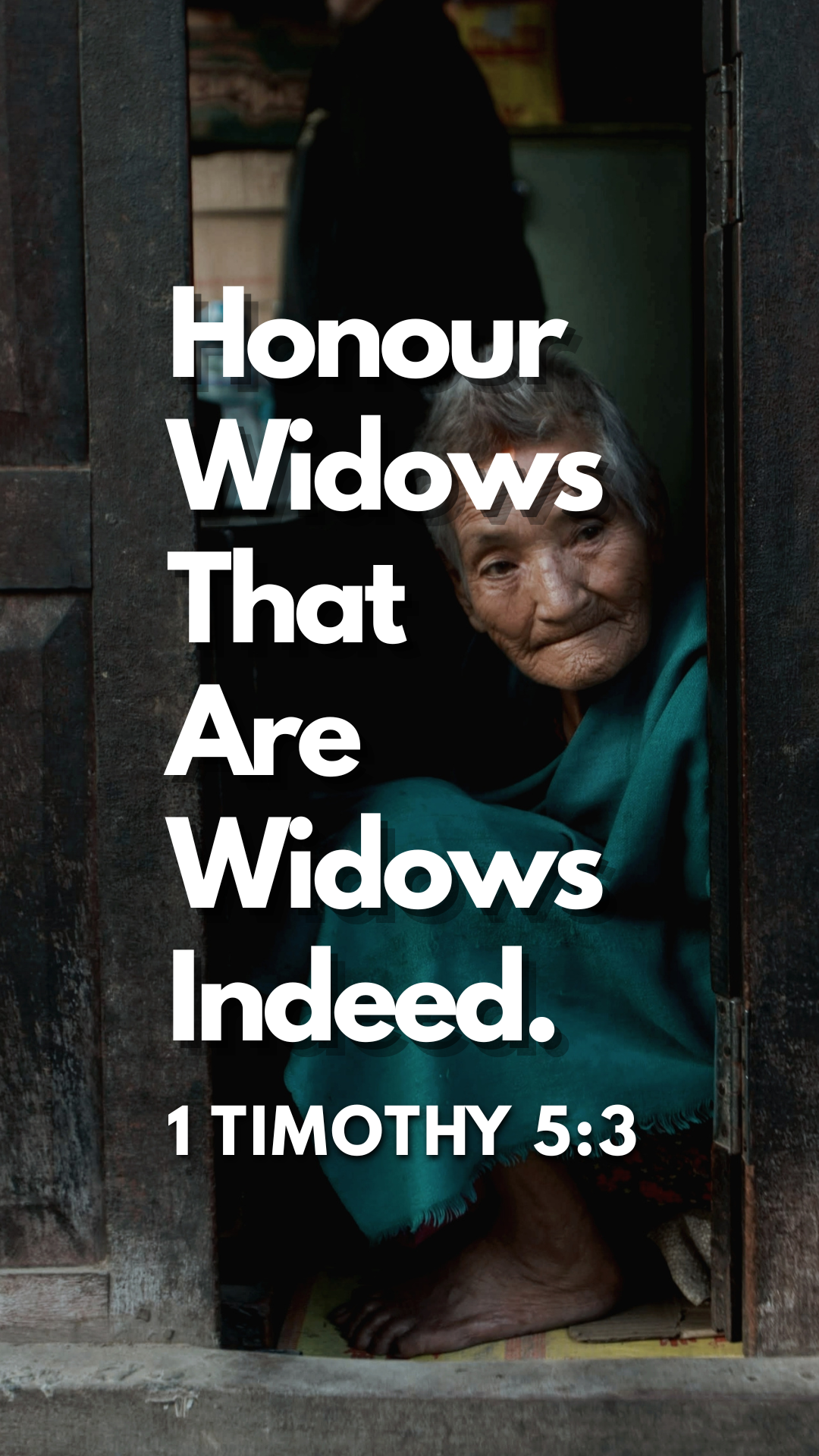
"Honour widows that are widows indeed." — 1 Timothy 5:3 (KJV)
What Does 1 Timothy 5:3 Mean?
In 1 Timothy 5:3, “Honour widows that are widows indeed” means the church was to support, financially and practically, the widows who had no family left to care for them and who trusted in God. It was a command to put real value on these women, not just to speak kindly about them.
Today “honor” sounds like a polite thank-you you say before walking away. That is not what Paul meant. Over the next few verses of 1 Timothy 5, he defines what honour looks like, who qualified for it, and who was supposed to carry the load first. It’s one of the most practical passages in the New Testament on biblical family duties.
Let’s walk through it.
What Does “Honour” Mean in 1 Timothy 5:3?
In 1 Timothy 5:3, the word “honour” means financial provision and respect, not just polite words. Paul makes this clear in verses 17 and 18 by tying honour directly to a worker’s pay.
The Greek word is timaō (tim-AH-oh). It means to prize someone, to put a real value on them. Think of it almost like a price tag. You are deciding what that person is worth to you, and then acting like it.
Scripture uses the word exactly that way. When Judas sold Jesus, Matthew uses the same verb for the price set on Him:
"Then was fulfilled that which was spoken by Jeremy the prophet, saying, And they took the thirty pieces of silver, the price of him that was valued, whom they of the children of Israel did value;" — Matthew 27:9 (KJV)
“Valued” and “did value” are both timaō, and “price” is its noun, timē. The word Paul uses for honouring widows is the word for setting a price. Israel valued the Son of God at thirty pieces of silver. Honour asks the same question: what is this person worth to you?
You can see how Paul uses the word just a few verses later:
"Let the elders that rule well be counted worthy of double honour, especially they who labour in the word and doctrine. For the scripture saith, Thou shalt not muzzle the ox that treadeth out the corn. And, The labourer is worthy of his reward." — 1 Timothy 5:17–18 (KJV)
So in this chapter, honour includes pay. When the church honoured a true widow, they weren’t just being nice to her. They were supporting her, with food, shelter, and money.
That means honouring someone shows up in your budget. Value, not just words.
What Does It Mean to Be a Widow Indeed?
A widow indeed is a woman who has lost her husband, has no family left to support her, and has put her whole trust in God. Paul describes her in 1 Timothy 5:5.
"Now she that is a widow indeed, and desolate, trusteth in God, and continueth in supplications and prayers night and day." — 1 Timothy 5:5 (KJV)
Notice the three marks:
- DesolateShe has nobody left to lean on.
- Trusts in GodShe trusts in God instead of falling apart.
- Keeps PrayingShe continues in supplications and prayers, night and day.
The very next verse shows the opposite kind of widow. Same loss, completely different life. Paul warns about the one who lives for herself and is dead while she liveth.
Why Did a Widow Have to Be Sixty Years Old?
Paul set the age at sixty because the church’s widow list was for women whose season of marrying and raising a household was behind them. Younger widows still had a full life God had ordered for them to step into.
"Let not a widow be taken into the number under threescore years old, having been the wife of one man," — 1 Timothy 5:9 (KJV)
Threescore is sixty. It sounds harsh at first. Who makes the cut? But Paul explains his reasoning a few verses later. For younger widows, his answer in verse 14 is, “I will therefore that the younger women marry, bear children, guide the house.”
And the list didn’t stop at age. Verse 10 adds that she had to be “Well reported of for good works.” There were standards, because the church was handing out real resources.
Did a Widow Have to Meet Every Qualification in 1 Timothy 5:10?
No. The list in 1 Timothy 5:10 was never a checklist where she had to check every box. Paul puts the word “if” in front of each item, five times over.
"Well reported of for good works; if she have brought up children, if she have lodged strangers, if she have washed the saints' feet, if she have relieved the afflicted, if she have diligently followed every good work." — 1 Timothy 5:10 (KJV)
If, if, if, if, if. Some of these women never had children at all. Some may never have had a house big enough to lodge strangers.
So the real question was never “Did she do every single one?” It was “What did she spend her life and her resources on? Herself, or God?”
Now turn that question around. Where are your money, your talents, and your brain going? Into shopping, fun, and stacking up worldly knowledge that just makes you look smart? Or into good works that actually build up the body of Christ?
One day, you will reap what you have sown.
Why Did the Early Church Turn Some Widows Away?
The early church turned some widows away because their own families were supposed to care for them first. That wasn’t the church being cold. It was the church putting care in God’s order.
"But if any widow have children or nephews, let them learn first to shew piety at home, and to requite their parents: for that is good and acceptable before God." — 1 Timothy 5:4 (KJV)
Requite means pay back. Your parents took care of you first, so now it’s your turn. That makes caring for elderly parents a matter of obedience, not just kindness.
Paul takes this seriously. A few verses later he warns that a believer who refuses to provide for his own family has denied the faith and is worse than an infidel.
Then verse 16 gives the reason behind the whole system:
"If any man or woman that believeth have widows, let them relieve them, and let not the church be charged; that it may relieve them that are widows indeed." — 1 Timothy 5:16 (KJV)
Family carried family, so the church could carry the widow who had nobody. Real help for real need. It was help, not a blank check.
What Does 1 Timothy 5:3 Mean for Us Today?
1 Timothy 5:3 still calls believers to put real value on the people God has placed in their care: honour that shows up in time and money, family first, and a life spent on good works.
A few questions to ask yourself this week:
- Does my honour show up in my budget?Respect that never costs you anything isn’t the kind of honour Paul is talking about.
- Am I carrying my own family?If God has given you parents, grandparents, or relatives in need, they come first. You may not be able to pay the bills yet, but you can start learning to show piety at home right now.
- What am I spending my life on?The widow indeed didn’t become devoted overnight. Verse 10 describes a lifetime of good works. Whatever you are sowing now is what you will be known for later.
This Week’s Verse
"Honour widows that are widows indeed." — 1 Timothy 5:3 (KJV)
Keep reading: what it means to be worse than an infidel, and why Paul says one kind of widow is dead while she liveth.
Honour isn’t a word you say —
it’s a value you live.
Watch This Week’s Videos
See every video for 1 Timothy 5:3 in this week’s YouTube playlist.
Watch the Playlist